I’ve heard many experienced cruisers joke that when you buy a boat, it should come with degrees in electrical engineering, mechanical engineering, meteorology, physics, geography, and a few other subjects you never realized you signed up for.
Unfortunately, most of us do not start out with all of those skills. We learn them over time through experience, mistakes, practice, and a lot of questions.
Cruising Consulting is intended to help expedite that process by providing hands-on, practical boating guidance tailored to you, your boat, and the way you plan to use it.
What is Cruising Consulting?
Cruising Consulting is individualized instruction and guidance for boat owners who want to become more comfortable, capable, and independent aboard their own vessel.
Rather than following a fixed curriculum, we focus on the skills and situations that matter most to you—such as docking, anchoring, navigation, weather, sailing, boat systems, maintenance, general seamanship, or preparing for longer-distance cruising.
The emphasis is practical: your boat, your experience level, and your goals.
Who is Cruising Consulting for?
Cruising Consulting can be useful for both new and experienced boaters, especially those who are:
- Moving to a larger or more complex boat
- Transitioning between sail and power
- Learning an unfamiliar vessel
- Building confidence with docking or anchoring
- Preparing for coastal, ICW, Bahamas, or extended cruising
- Returning to boating after time away
- Looking to improve sailing or boat-handling skills
Experience in one type of boating does not always transfer directly to another. The goal is to build on what you already know.
Can Cruising Consulting help couples learn together?
Cruising couples often begin with different levels or types of experience. One partner may be experienced while the other is not, both may be relatively new, or each may bring different strengths.
In all three cases, communication and shared procedures can be just as important as individual skill.
Cruising Consulting can help both partners get on the same page by developing clear routines, defining roles, and practicing important procedures together.
This is something I understand from personal experience. When my wife and I first started cruising, we had to learn how to communicate effectively and develop procedures that worked for both of us. That experience helps me guide other couples through the same process.
What if I already know a lot from YouTube, books, or online courses?
There is more high-quality boating and cruising information available online than ever before, and that is a great thing. It has introduced many people to cruising who may never have considered it otherwise.
The challenge is that theoretical knowledge and real-world experience are not the same thing.
Online content cannot fully replicate handling your own boat when the wind picks up, the docking plan changes, the anchor does not set, or something aboard stops working the way you expected. It also tends to highlight the adventure while compressing the mistakes, frustration, failures, and learning curve that often come with the first years on the water.
That can leave new owners feeling prepared in theory but less prepared in practice.
Cruising Consulting helps bridge that gap. With hands-on, practical boating guidance early on, many common rookie mistakes can be avoided or handled more confidently when they happen, making the transition into cruising safer, less frustrating, and more enjoyable.
What kinds of things can we work on?
The scope can be broad or focused depending on your goals.
Common areas include docking, anchoring, line handling, crew communication, navigation, tides and currents, weather, boat handling, sailing, onboard systems, maintenance, and preparing for longer-distance cruising.
In many cases, focusing on a few specific areas provides more value than trying to cover everything at once.
Can you help me learn the systems on my own boat?
Maintenance and boating go hand in hand. Anyone who wants to become a more autonomous cruiser should understand their boat well enough to recognize problems, handle routine maintenance and simple repairs, and know when it is time to call a professional.
A thorough marine survey is one of the best places to start. Shadowing the surveyor can help you understand the boat’s systems, condition, maintenance needs, and likely problem areas.
Cruising Consulting can build on that foundation. Over multiple days, the trip can also serve as a shakedown cruise, helping identify maintenance issues, operational problems, and areas where the boat could be improved.
If systems and maintenance are not yet one of your strengths, I can help you develop a practical maintenance list, explain common failure points, demonstrate appropriate routine tasks, review needed repairs, and discuss future improvements.
This is especially easy if I performed the Pre-Purchase Survey, but we can also work from another surveyor’s report.
Do you teach sailing?
Sailing is really my bread and butter. I have been sailing, racing, and teaching since I was a teenager, and one of the biggest lessons I have learned is that good sailing does not have to be complicated.
You do not need a stack of books or a PhD in physics to sail well. The best sailors tend to keep things simple by relying on sound principles, repeatable routines, and a good feel for what the boat is telling them.
At the highest levels of racing, that feel takes years to develop. The difference in speed and efficiency between a competent sailor and a highly experienced sailor or racer may only be a few percent. On a race course, that can mean the difference between first and last place. When cruising, it may just mean you get to drop the hook and pour your first cocktail 30 minutes before the other guy.
My goal is to take decades of sailing experience and distill it into simple, practical concepts that help you sail the boat effectively and, most importantly, safely. Some people pick it up quickly; others need more time and repetition.
Although I am a racer at heart, my instruction is primarily focused on cruising skills, safety, and confidence—not squeezing the last tenth of a knot out of the boat. If you eventually want to learn racing, that can become a much deeper journey.
Is Cruising Consulting the same as hiring a captain?
Hiring a captain and hiring a cruising consultant serve different purposes.
A captain is generally hired to operate or deliver the vessel. If the owner comes along, there may be opportunities to learn, but instruction is usually secondary to completing the trip.
With Cruising Consulting, the primary goal is learning.
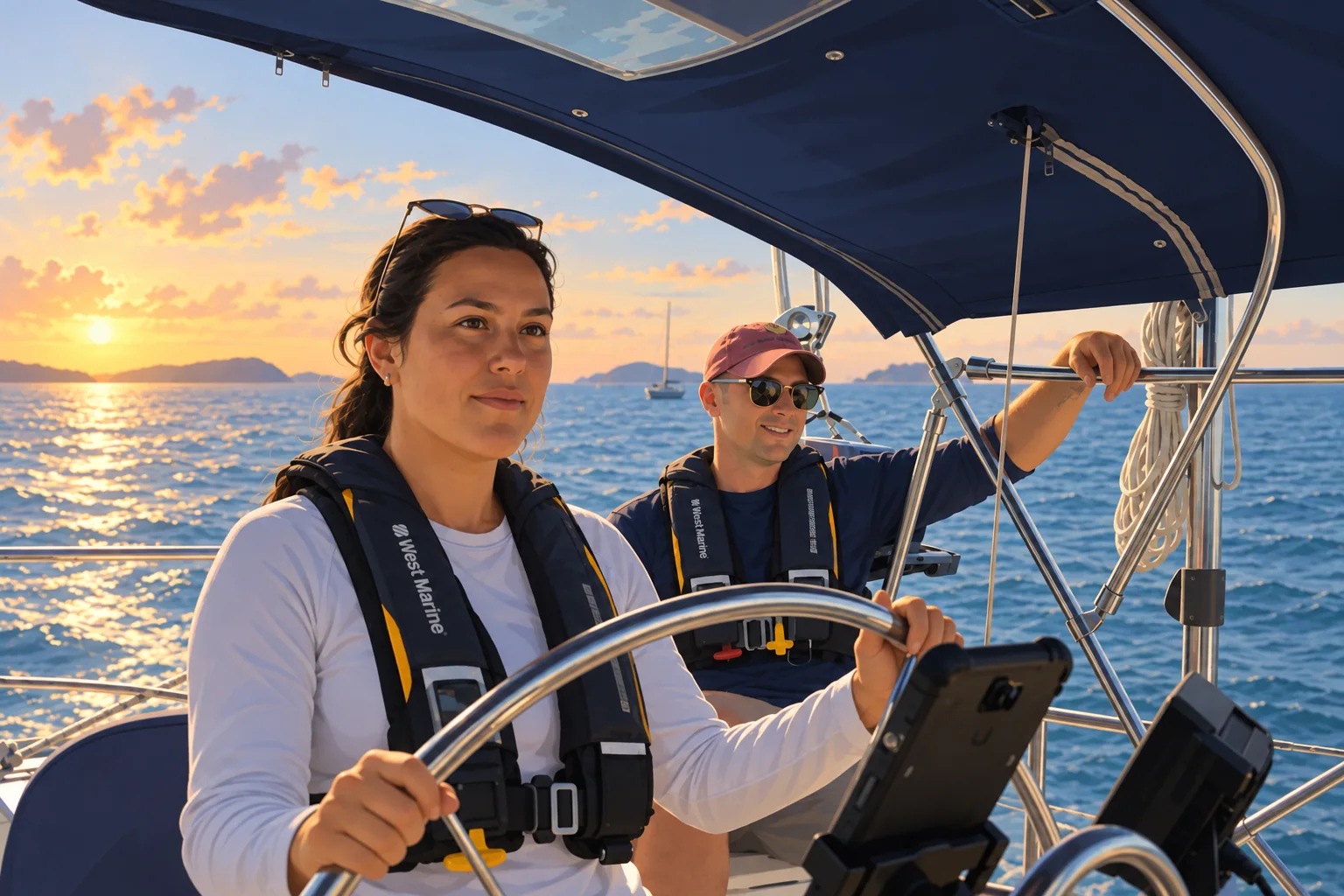
You will normally be at the helm, handling the sails, docking, anchoring, line handling, and operating the boat while I coach you through the process. I may demonstrate a technique when useful, but the focus is on building your skills rather than watching someone else operate your boat.
We can still cruise from one location to another—in fact, that can be one of the most effective ways to learn. I would only take control if you asked me to demonstrate something or if an unexpected situation made it necessary.
The idea is to give you a safe, supported way to step into the “deep end” without being thrown in alone.
Can you travel with me aboard my boat?
Multi-day cruising is one of the most effective ways to provide Cruising Consulting because it closely reflects real-world boating. It allows navigation, weather, docking, anchoring, onboard systems, and everyday decision-making to come up naturally.
Sessions can begin with local day trips and progress to overnight or multi-day cruising as your experience grows. For someone with limited experience, I would usually recommend starting close to home rather than immediately taking on a demanding offshore passage.
If the vessel can reasonably accommodate another person overnight, I am happy to stay aboard. In some cases, I may also recommend that my wife join us. She is an experienced cruiser, and having both of us aboard can be especially helpful when working with couples who are learning together.
The goal is to build skills progressively without taking on more than you are ready for. Longer trips can be arranged, although I would generally limit an individual session to about one week.
How long does Cruising Consulting last?
Cruising Consulting is generally offered by the day, but the schedule can be tailored to the client.
Some owners may only need a focused day of docking, anchoring, or boat handling. Others may benefit from several days aboard, particularly when learning a new vessel or preparing for extended cruising.
The appropriate length depends on the boat, your experience, and what you want to accomplish.
How much does Cruising Consulting cost?
Cruising Consulting generally ranges from $500 to $750 per day, depending on the scope, vessel, location, and amount of preparation involved.
Travel or mileage may apply outside the normal service area, and longer or multi-day arrangements may require a custom quote.
View survey and consulting pricing details.
Request Cruising Consulting
Steel Rose Marine Services provides Cruising Consulting from New Bern, NC, serving boat owners throughout Eastern North Carolina and the Mid-Atlantic. Our goal is to provide practical instruction, straightforward guidance, and useful information that helps you build practical skills and greater confidence operating your vessel.
Request Cruising Consulting